
The Top Artists That AI Users Copied in 2025
Dec 29, 2025
The latest generative AI tools enable you to create whatever visuals may come into your head, with custom variations of fantastical scenes, things you've imagined, that complement your stories, or that you just really want to see for whatever reason. Yet generative AI tools are also derivative, in that they can only replicate existing artworks and images to create something new. So it's not really new, and at the same time, most people have visions in mind that relate to artworks they've already seen, like a modern city in the style of Monet.
Many users prompt AI tools using references to existing artists to customize the look of their generations. To find out which artists are most replicated by AI based on prompts from users, Kapwing analyzed the Midjourney Discord to see how many times popular artists, architects, and directors were named. Across nearly 5 million prompts, this listing shows the most replicated artists within AI generations. Note that many artists or their families are looking to restrict their names from AI prompts, so this might not even be possible in future, but at present, these are the artists and styles that get the most AI attention.
The Most Prompted Artists Reveal Style Appropriation at Scale
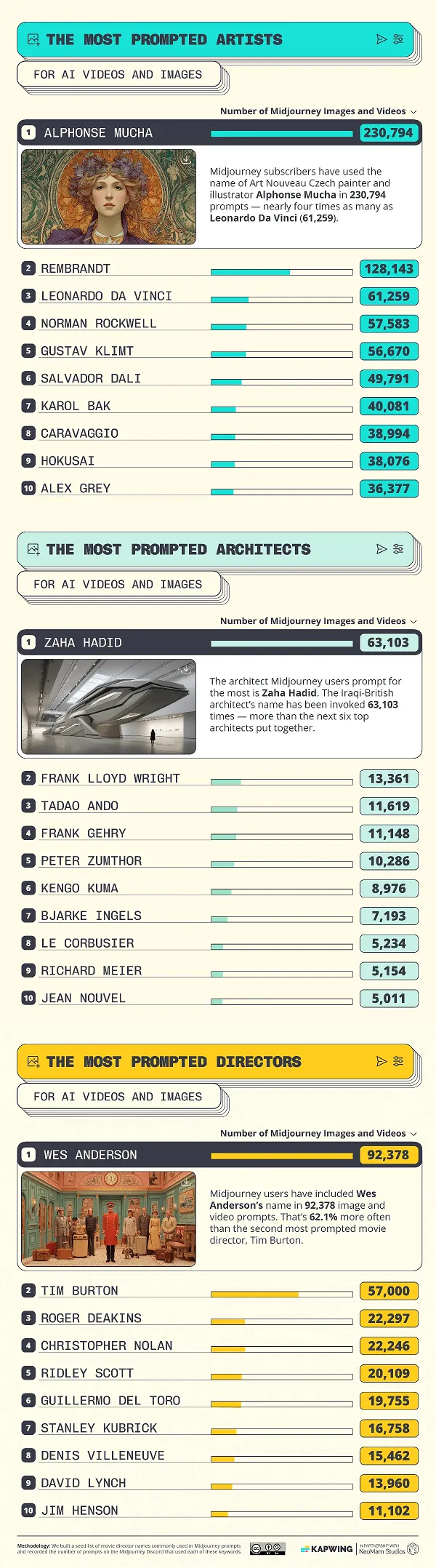
Alphonse Mucha dominates AI art prompts with 230,794 Midjourney references—nearly four times as many as Leonardo da Vinci at 61,259. Midjourney subscribers have used the name of Art Nouveau Czech painter and designer Alphonse Mucha in prompts far more than any other artist. Rembrandt comes in second with 128,143 references, followed by Leonardo da Vinci, Norman Rockwell with 57,583, Gustav Klimt with 56,670, Salvador Dali with 49,791, Karol Bak with 40,081, Caravaggio with 38,994, Hokusai with 38,076, and Alex Grey with 36,377.
For architects, Zaha Hadid leads with 63,103 Midjourney prompts—more than the top five architects combined. The Iraqi-British architect's name has been invoked 63,103 times in prompts. Frank Lloyd Wright follows with 13,361, Tadao Ando with 11,619, Frank Gehry with 11,148, Peter Zumthor with 10,286, Kengo Kuma with 8,976, Bjarke Ingels with 7,193, Le Corbusier with 5,234, Richard Meier with 5,154, and Jean Nouvel with 5,011.
For directors, Wes Anderson dominates with 92,378 Midjourney references—that's 62.1% more than the second most prompted movie director, Tim Burton at 57,000. Roger Deakins has 22,297, Christopher Nolan 22,246, Ridley Scott 20,109, Guillermo del Toro 19,755, Stanley Kubrick 16,758, Denis Villeneuve 15,462, David Lynch 13,960, and Jim Henson 11,102. These numbers reveal which visual styles users most want to replicate through AI generation. Understand how AI systems work to grasp both capabilities and ethical implications of style replication.
The Copyright Question Nobody Wants to Answer
The data reveals massive-scale appropriation of artistic styles without compensation or consent. When users prompt "in the style of Alphonse Mucha" 230,794 times, they're leveraging distinctive visual aesthetics that Mucha developed over decades of artistic practice. The AI training process ingested Mucha's work without permission or payment, then enables millions of users to generate Mucha-style images that compete with his actual work in commercial contexts.
This raises uncomfortable questions about intellectual property that current copyright law struggles to address. Is an AI-generated image "in the style of Rembrandt" a derivative work requiring permission? Does style constitute copyrightable expression, or only specific compositions? Can artists whose work trained AI systems claim compensation for every generation that references their style? The legal frameworks don't provide clear answers because they predate technology enabling industrial-scale style replication.
Living artists face particularly acute problems. Karol Bak, a contemporary digital artist, appears in the top ten most-prompted artists with 40,081 references. Unlike Rembrandt or Leonardo da Vinci whose work entered public domain centuries ago, Bak is actively creating and selling work today. AI generations "in the style of Karol Bak" directly compete with his actual commissions. Why hire Bak when you can generate unlimited Bak-style images for $30 monthly Midjourney subscription?
The Creativity Paradox in Derivative Generation Systems
Users claim they're creating new works, but they're fundamentally remixing existing artistic DNA into novel combinations. The phrase "generative AI tools are also derivative" captures this paradox perfectly—the systems generate new images, but only by recombining patterns learned from existing artwork. There's no original creative vision in AI generation, just sophisticated pattern matching and interpolation between training examples.
This challenges romantic notions of AI as creative partner or artistic tool. Traditional tools like brushes, cameras, or Photoshop enable artists to express creative visions. They don't generate the vision—they execute it based on artist input. AI image generators do generate visual output, but that output derives entirely from training data. The "creativity" is selecting which existing styles to combine, not creating original aesthetic vocabulary.
The most-prompted artists list reveals this derivative nature explicitly. Users don't prompt "create something nobody has ever seen before"—they prompt "Alphonse Mucha" or "Wes Anderson" because they want to replicate recognizable styles. The appeal is access to professional-quality aesthetics without developing artistic skills or hiring artists. This is style appropriation productized at scale. Learn how to build authentic creative strategies that develop original voice rather than appropriating others' styles.
Why Mucha and Anderson Dominate Their Categories
Alphonse Mucha's dominance—230,794 prompts, nearly double second-place Rembrandt—likely reflects his distinctive, immediately recognizable Art Nouveau style that translates well to AI generation. His flowing lines, decorative borders, and idealized figures create consistent visual vocabulary that AI systems replicate effectively. The style is ornate enough to look sophisticated but structured enough for consistent generation. Similarly, Wes Anderson's cinematic style—symmetrical compositions, pastel palettes, quirky production design—provides clear visual template that AI can systematically apply.
The artists who perform best in AI prompts aren't necessarily the most influential or respected in art history—they're the ones with most codifiable, replicable visual signatures. Rembrandt's dramatic lighting and psychological depth, Klimt's decorative gold leaf patterns, Norman Rockwell's nostalgic Americana—these styles have clear visual parameters that AI systems can learn and reproduce. Abstract expressionism or conceptual art, which depend on context and artistic intent rather than surface aesthetics, don't translate as well to prompt-based generation.
This creates selection pressure toward certain artistic approaches over others. If AI generation favors ornate, decorative, highly stylized work over conceptual or minimalist approaches, cultural production gradually shifts toward what AI replicates well. We're already seeing this in commercial illustration where clients increasingly request "AI-friendly" styles that can be easily modified or replicated through generation rather than commissioning unique artistic visions that don't reduce to prompt parameters.
The Restriction Movement and Name Protection
Many artists or their families are looking to restrict their names from AI prompts, so this might not even be possible in future. This resistance takes multiple forms: legal action against AI companies for copyright infringement, technical tools like Glaze that make artwork harder for AI to learn from, industry pressure for opt-out mechanisms that let artists exclude their work from training data, and estate management by families of deceased artists seeking to protect artistic legacies from AI appropriation.
The effectiveness of these approaches remains unclear. Legal frameworks weren't designed for AI training scenarios, making copyright claims uncertain. Technical protections face arms race dynamics where AI systems evolve to overcome them. Opt-out mechanisms only work if widely adopted and retroactively applied to existing models. Estate management becomes complex when artwork is already in public domain but artist name is used as style descriptor rather than claiming to be actual work.
The fundamental tension is that AI systems need training data to function, but comprehensive permission systems would make training economically infeasible. If AI companies had to license every artwork used in training at fair market rates, development costs would skyrocket and possibly prevent AI image generation from existing as consumer product. This creates misaligned incentives where AI companies prioritize development over artist compensation because their business models depend on free training data access.
What This Means for Marketers Using AI-Generated Images
For marketers, the most-prompted artists data reveals both opportunities and risks. Opportunities include accessing professional-quality visual styles without design budgets or artistic skills. Risks include potential copyright liability as legal frameworks evolve, brand association with ethically questionable practices that appropriate artist work without compensation, and visual homogenization as everyone uses the same prompted styles rather than developing distinctive brand aesthetics.
The strategic question is whether short-term cost savings from AI-generated imagery justify long-term risks around copyright claims, brand differentiation, and ethical positioning. Brands that position themselves around creativity, artistic support, or ethical business practices face particular tension using AI generation that appropriates artist styles without compensation. Even brands without explicit ethical positioning risk backlash as awareness grows about how AI training works and which artists get referenced most frequently.
Smart marketers will develop policies around AI image use that consider these factors explicitly. This might include avoiding prompts that reference specific living artists, commissioning human artists for primary brand assets while using AI for secondary materials, being transparent about AI use rather than trying to pass generations as human-created work, and supporting policy frameworks that compensate artists whose work trains AI systems. Explore data-driven marketing approaches that balance efficiency with ethical considerations.
The Future of Style as Intellectual Property
The most-prompted artists data reveals gaps in how intellectual property law handles artistic style. Copyright protects specific expressions but not styles or techniques. You can't copyright impressionism, Art Nouveau, or symmetrical composition with pastel palettes. But when AI systems enable industrial-scale style replication that directly competes with artists who developed those styles, existing frameworks seem inadequate.
Future legal evolution might create new intellectual property categories that protect style separate from specific works. This would require balancing artist interests against creative freedom—where does legitimate artistic influence end and actionable appropriation begin? Alternatively, frameworks might focus on AI training data use rather than generation outputs, requiring compensation when systems train on copyrighted work regardless of whether specific outputs infringe. Or courts might determine current law already covers AI appropriation through derivative work doctrine, making most AI generations legally questionable.
Navigate AI Ethics at The Academy of Continuing Education
The most-prompted artists data reveals industrial-scale appropriation of artistic styles through AI generation. The 230,794 Alphonse Mucha prompts and 92,378 Wes Anderson references represent millions of generations leveraging distinctive aesthetics these artists developed without compensation or consent. The marketers who thrive will be those who understand both capabilities and ethical implications of AI generation, making strategic decisions about when and how to use these tools responsibly.
Ready to build creative strategies that balance AI capabilities with ethical considerations and brand differentiation? Join The Academy of Continuing Education and develop the critical thinking frameworks ambitious marketers need to navigate AI's transformation of creative work.
GET ON OUR NEWSLETTER LIST
Sign up for new content drops and fresh ideas.
